
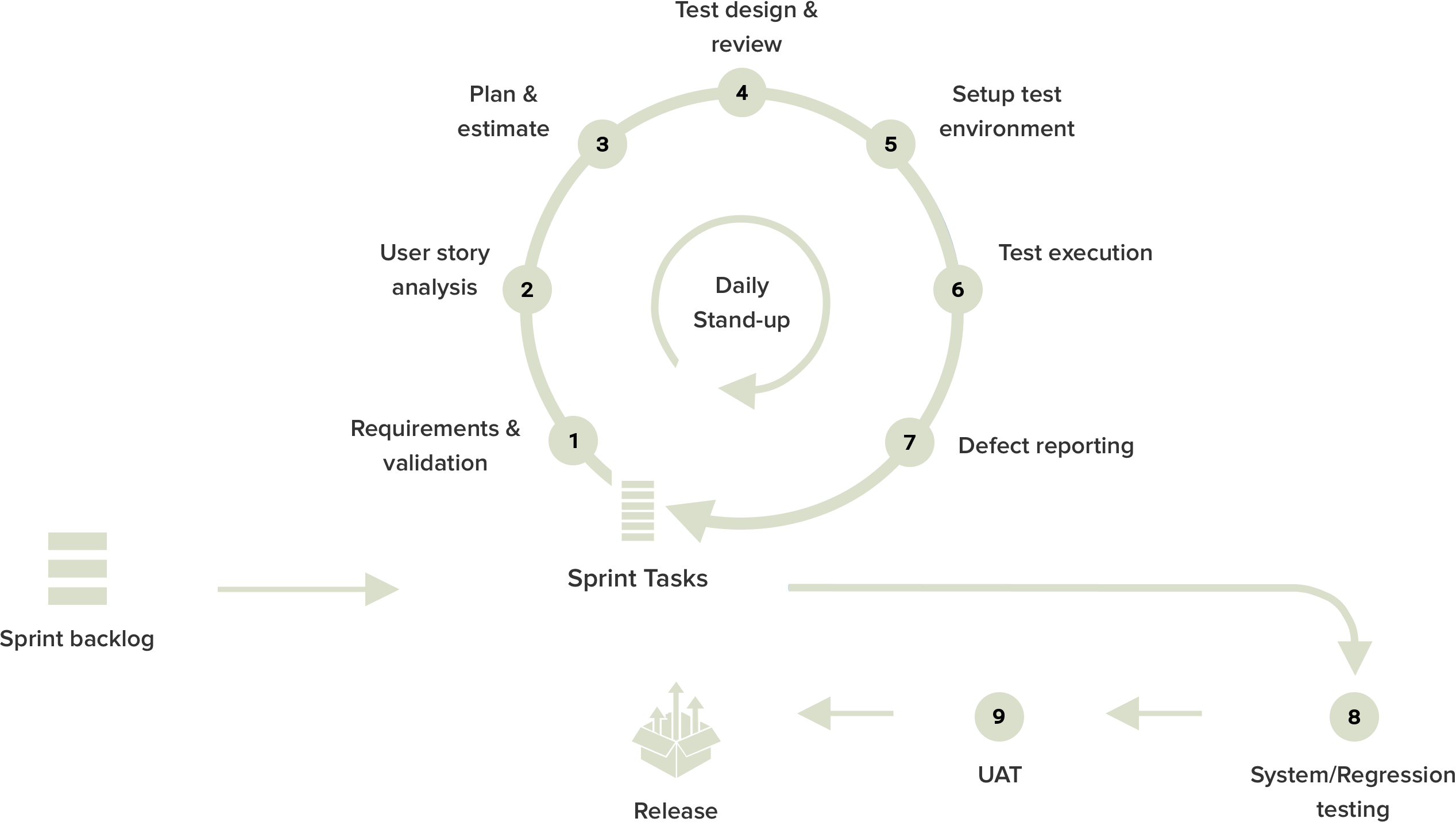
Agile testing is a software testing process that follows the principles of agile software development. Agile testing is a continuous process - the testing begins at the start of the project and there is ongoing integration between testing and development. The common objective of agile development and testing is to achieve high product quality.
Process
Agile Testing
Testing
Functional testing
Software testing whereby the system is tested against the functional requirements. Functional testing ensures that the requirements are properly satisfied by the application.

Benefits
Improve the overall quality of the product
Validate the stated business requirements are met
Increase customers satisfaction in your product
How we do it?
Identify the functional requirements of the project
Create input data based on the specifications
Determinate the output based on the specifications
Write test cases
Execute the test cases
Analyse and document the results

User acceptance testing
User acceptance testing is usually the last phase of the software testing process. During UAT, actual s oftware users or volunteers test the software to make sure it can handle required tasks in real-world scenarios, according to specifications. User acceptance testing is one of the final and most critical software project procedures.

Regression testing
Regression testing is a type of software testing that intends to ensure that changes to the software have not adversely affected it. The likelihood of any code change impacting functionalities that are not directly associated with the code is always there and it is essential that regression testing is conducted to make sure that fixing one thing has not broken another thing.

Ad-hoc testing
Ad-hoc testing is an informal testing type with an aim to break the system. This testing does not follow any test design techniques to create test cases. It is primarily performed if the knowledge of testers in the system under test is very high. Testers randomly test the application without any test cases or any business requirement document.

End-to-End testing
End-to-end testing is a type of testing used to test whether the flow of an application is performing as designed from start to finish. The purpose of carrying out end-to-end tests is to identify system dependencies and to ensure that the right information is passed between various system components and the systems.
Testing
Non-functional testing
Non-functional testing is used to verify the software application or system for its non-functional requirements. These are requirements that does not relate to functionality, but to attributes such as reliability, efficiency, usability, maintainability and portability.

Benefits
Ensure that the application runs efficiently and is reliable enough
Reduce production risk and cost associated with product requirements
Cover project aspects which cannot be covered in functional testing
Collect and produce measurements, and metrics for internal research
How we do it?
Identify the Acceptance Criteria based on the client’s/project requirements
Identity the Test Environment that will be used
Determinate the output based on the specifications
Configure the Test Environment
Implement and execute the tests
Analyse the results, create reports and retest if needed
Performance testing
Performance Testing measures the response time of an with a normal number of users. The goal of this is to get a baseline and an indication of how an application behaves under expected conditions. It assures the application under test meets the required response time.
Load testing
Load Testing measures the response time of an application when it is subjected to more than the usual number of users. The response time will increase, i.e. the application will be slower under heavy load, but the aim of load testing is to see whether the application can sustain the increased load on the server or will it crash and kill the servers.
Stress testing
Stress testing evaluates a system or component at or beyond the limits of its anticipated or specified workloads, or with reduced availability of resources such as access to memory or servers. The aim of stress testing is to ensure that under a constant load for a long duration, the servers don’t crash, albeit responding slowly.
Testing
Automation Testing
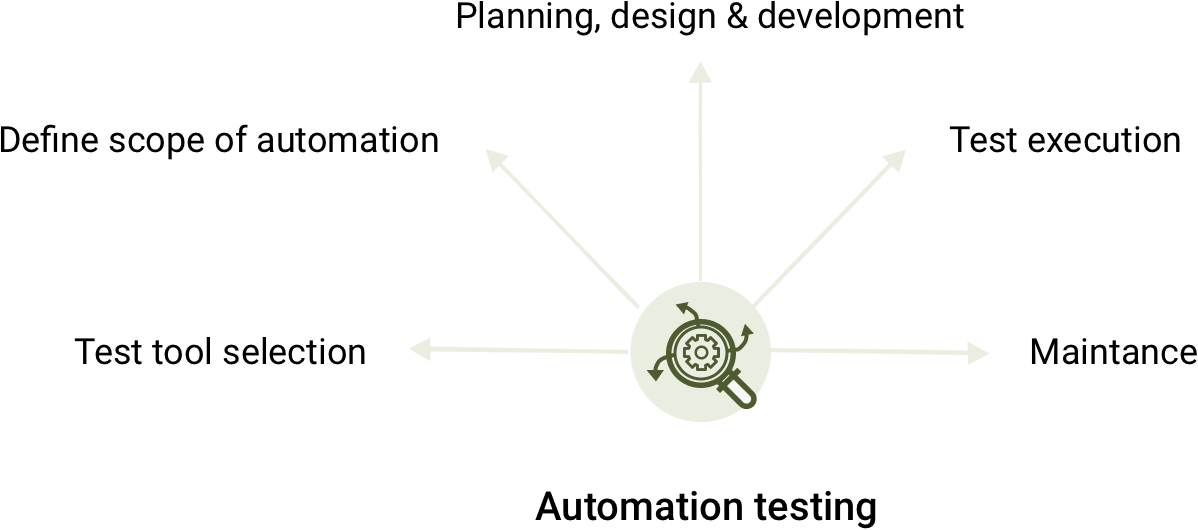
Automation testing reduces the testing effort and time – without compromising on quality. If it is properly planned and performed, the expenses are returned in the ultimate result due to the saving of time and efforts. Automation is especially beneficial for test cases that are executed repeatedly, e.g., those for cross-browser compatibility, and those that are part of regression suites.
Benefits
Reduced expenses for fixing issues
Less execution time
Increased test coverage
Get faster feedback
How we do it?
Analyse automation feasibility and ROI
Evaluate and select test automation tools
Design and implement test automation framework
Develop and execute automated tests
Analyse results and create reports