

By using Scrum, we develop new features incrementally in Sprints. At the end of each Sprint (weekly or bi-weekly) we are able to view a potentially releasable Increment of the Product. This enables the product team to get quick feedback from all stakeholders and ensures that the right product is being built.
Agile
Using Scrum
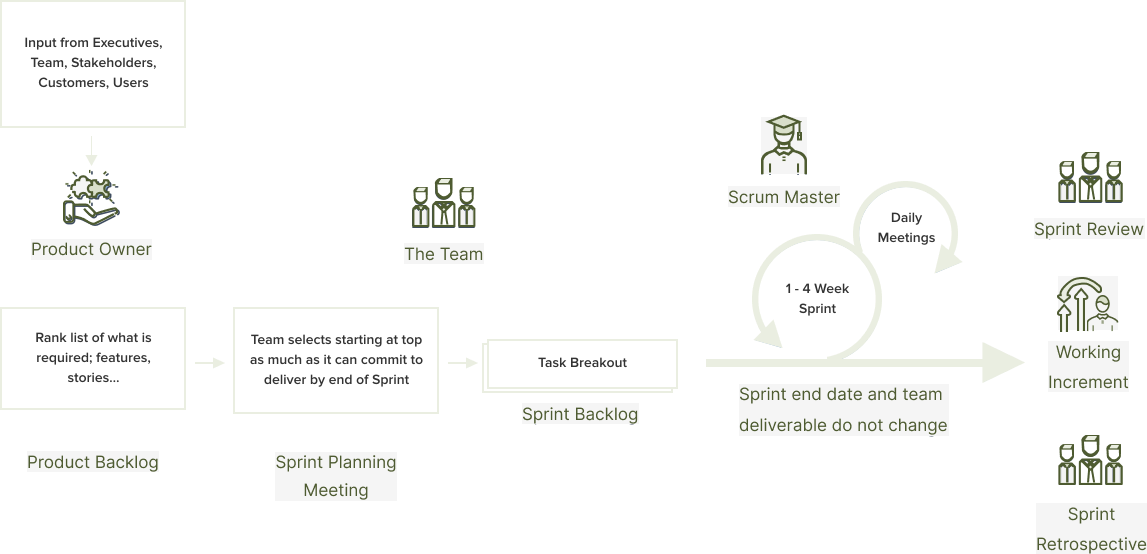
GAIN
Benefits of Scrum

Quality
Testing occurs every Sprint, enabling regular inspection of the working Product as it develops.

Transparency
Scrum development encourages active Product Owner and Stakeholder involvement throughout the Products development.

Risk
Small Increments of working Product made visible to the Product Owner help to identify any risks early and make it easier to respond to them.

Agility
In agile development, change is accepted and expected. Often the time is fixed and detailed requirements emerge and evolve as the product is developed.

Cost Control
The scope of the product and its features are variable, rather than the cost. We can measure the real cost of development of slices of functionality.

Customer satisfaction
The active involvement of a Product Owner, the high transparency of the product and progress, and the flexibility to change, create business engagement and customer satisfaction.

Valuable product
The ability for requirements to emerge and evolve, and the ability to embrace change help ensure the Scrum Team build the right Product.
Agile Development Process
Using Kanban
Using Kanban lean software development methodology can change requirements on-the fly based on actual business feedback. Kanban focuses on just-in-time delivery of functionality and managing the amount of work in progress (WIP).
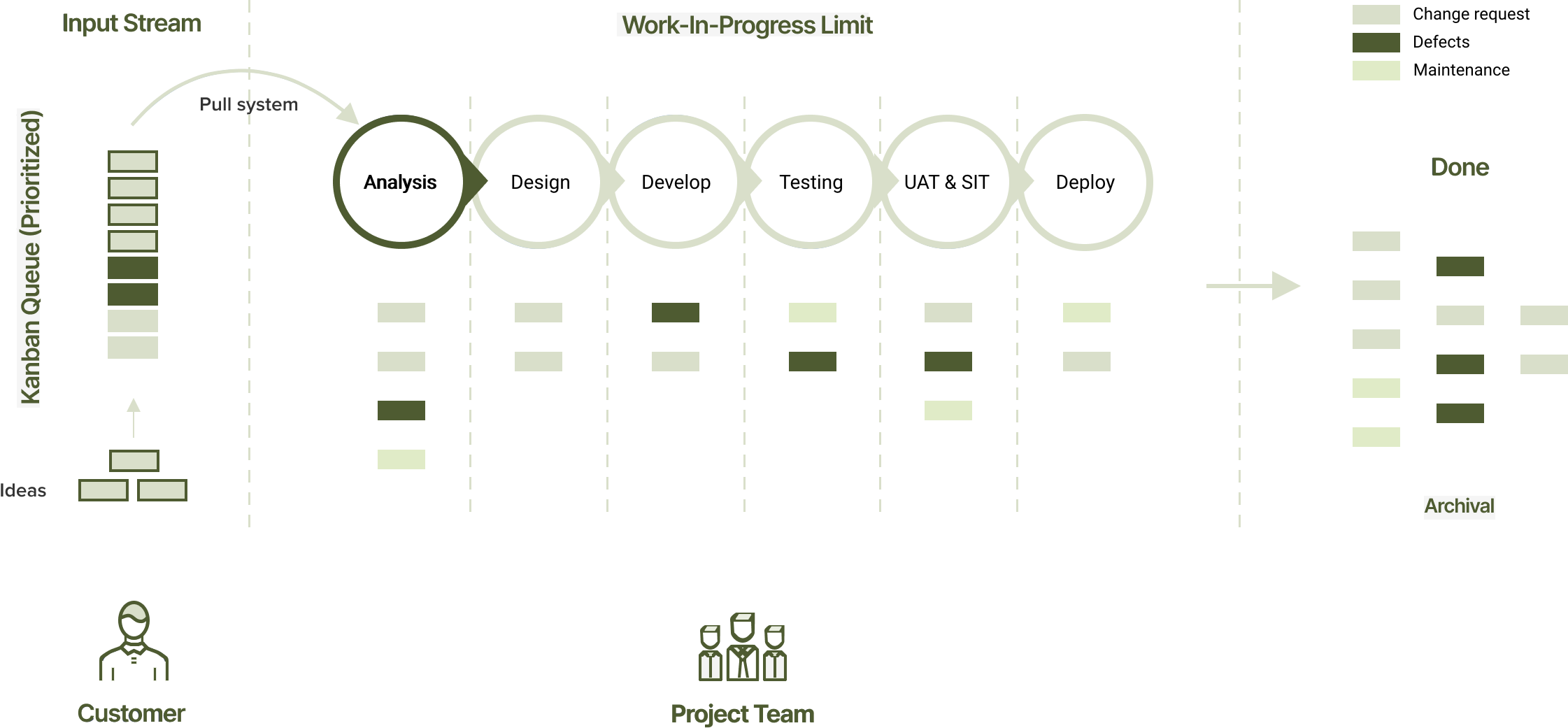
GAIN
Benefits of Kanban

Flexibility
Changing requirements on the fly without any resistance from our developers. As soon as new feature is in production it can be changed according to the feedback.

Continuous delivery
By delivering small portions of a project continuously to the stakeholders, teams synchronize future iterations with the updated business requirements.

Improves Visibility
Kanban information board offers the holistic view of bottlenecks, progress, blockers, process inefficiencies and impediments at a glance.

Business Value First
Promotes cost-based decision-making to identify, prioritize, and execute the most value-added works at the earliest.

Reduces Context-Switching
The ‘Personal WIP Limits’ in Kanban Agile methodology relieves the teams from being overburdened.

Makes Predictions Reliable
The predictions based on the latest real data are more reliable rather than the project manager’s guess.

Introduces Kaizen Culture
The flow-based on-time smooth delivery of software reduces the cost and effort invested for inventory management.
Agile Development Process
Large Scale Team
Building world class products for large user base or enterprise organizations requires a full team of specialists, often divided into multiple teams. We have experience in setting up large development organizations ranging from 20 to 100+ people, ensuring that all required processes are in place and best practices for software development are followed.
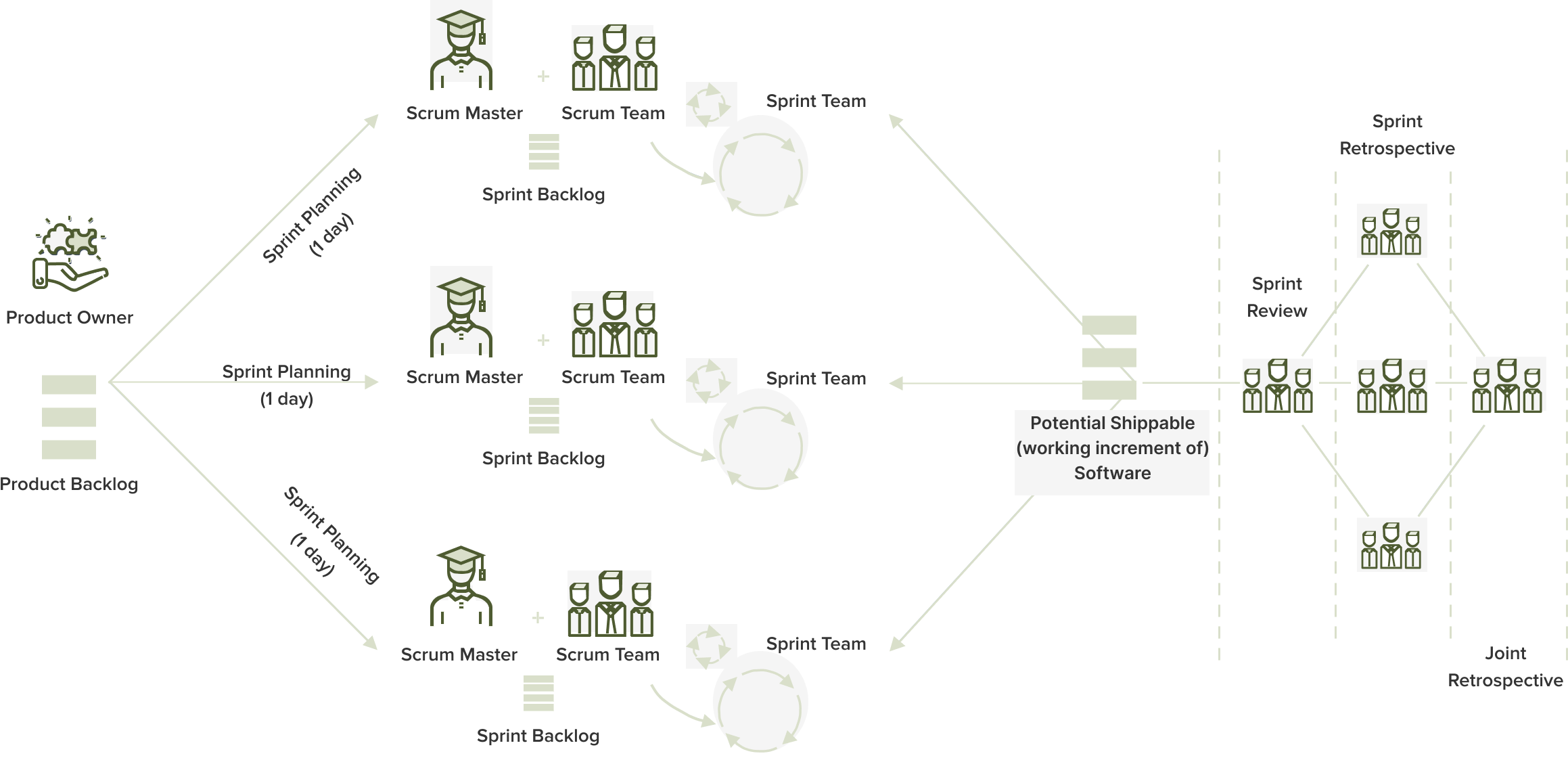
Team Roles & Responsibilities
A typical product development team consists of Product Owner, Software Architect, UX/UI Designers, Engineering Manager, Software Engineers, QA Engineer, DevOps Engineer.

Product Owner
The product owner is a key role in the development of a software product. He conveys the vision for the product to the development team. The product owner delivers a list of features that must be built, prioritises this list and takes part in the software demos as main stakeholder approving if the feature is delivered properly or not.

Engineering Manager
Engineering Manager or Tech lead is a software engineer responsible for the technical quality of the delivered product in the development team. The tech lead establishes the technical vision with the development team and the architect.

UX/UI Designers
UX/UI Designers are responsible for collecting, researching and analysing clients’ requirements. They are responsible for delivering an outstanding User eXperience incorporated into an intuitive and modern application design with attention to detail.

Software Architect
Software architects are responsible for designing, developing and implementing software solutions to address complex business issues, and providing technical leadership within the IT department. They troubleshoot code level problems quickly and efficiently, evaluate and recommend tools, technologies and processes to ensure the highest quality product platform.

Software Engineer
Software engineers are responsible for the development, maintenance and testing of a software product. They have the knowledge, expertise and ability to identify problems before they arise and fix them before they become an issue. The main responsibilities of the software engineers are analysing product requirements, solving technical challenges and producing high quality code.

Quality Assurance Engineer
The QA Engineers play an important role in the product development process as they oversee the entire process, including software testing, from start to finish. They are responsible for making sure the application meets business quality standards. Writing and running automated tests, conducting experiments and manual testing on different devices are parts of their day-to-day responsibilities.

DevOps Engineer
DevOps engineers collaborate with stakeholders and team members to design and develop DevOps solutions in a large scale environment. With attention to detail and dedication to quality, strong knowledge of Unix/Linux, networking, release tools, system and network analysis tools, understanding of CI/CD and various monitoring platforms they support the whole development process.
Managing Agile Projects
Software development projects often fail because the organization sets unrealistic goals for the "iron triangle" of software development: Scope (what must be built), Schedule (when it must be built by), Resources (how much it must cost).
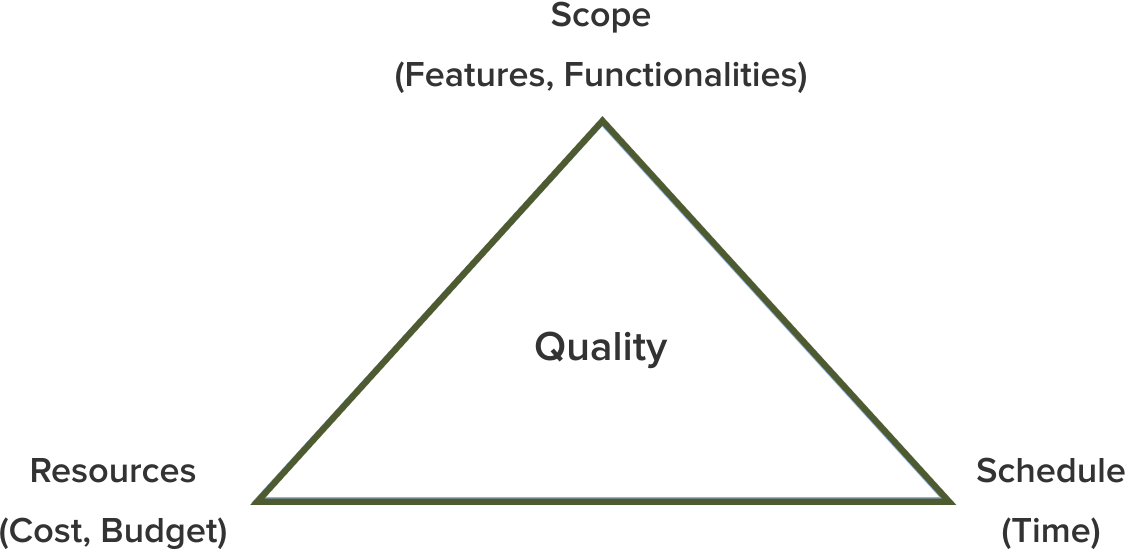
Managing a project with unclear requirements, high levels of change, and/or a team using agile methodology requires stakeholders to be aware of the "iron triangle". It is critical to understand how flexible you are in respect with each vertex and to vary the cost, schedule, and/or scope as required.

Vary the scope
This is done by timeboxing, which enables the fixing of resources and schedule by dropping low-priority features out of an iteration when you’ve run out of time.

Vary the schedule
The scope and the resources can be set and then the schedule can vary by varying the number and type of people on the team which enables the delivery of the required functionality at the desired cost.

Vary the resources
When the schedule and scope are set there might be a need to hire more and/or better people to deliver the system. However, remember that there are limits to this approach: nine women can't deliver a baby in one month.

Vary two or more factors
It isn't always possible to vary just one factor. For example, it isn't possible to build an air traffic control system from scratch in a single week regardless of how much money you're willing to spend.